
This guide distinguishes documented platform guidance from practical observations. AI and search platforms can change, and no placement or recommendation is guaranteed.
Before you start
Improve the public facts and answers you control, without promising an AI mention.
- One real service page and the business facts its owner can confirm.
- Access to edit that page or a clear brief for your website person. No paid report is required.
Step by step: make one service page easier to understand
Choose a service customers actually buy. You are improving the page for people and search eligibility, not submitting it for a guaranteed recommendation.
Write down what the business can confirm.
Name the service, who it is for, where it is available, what is included, important exclusions and how to book or request an estimate. Mark any unknown price, turnaround or guarantee for owner confirmation.
Read the existing page and its useful links.
Look for those answers in the page and linked FAQs. If a linked guide already explains the process, add a helpful route to it rather than duplicating the entire answer.
Replace a vague claim with a useful answer.
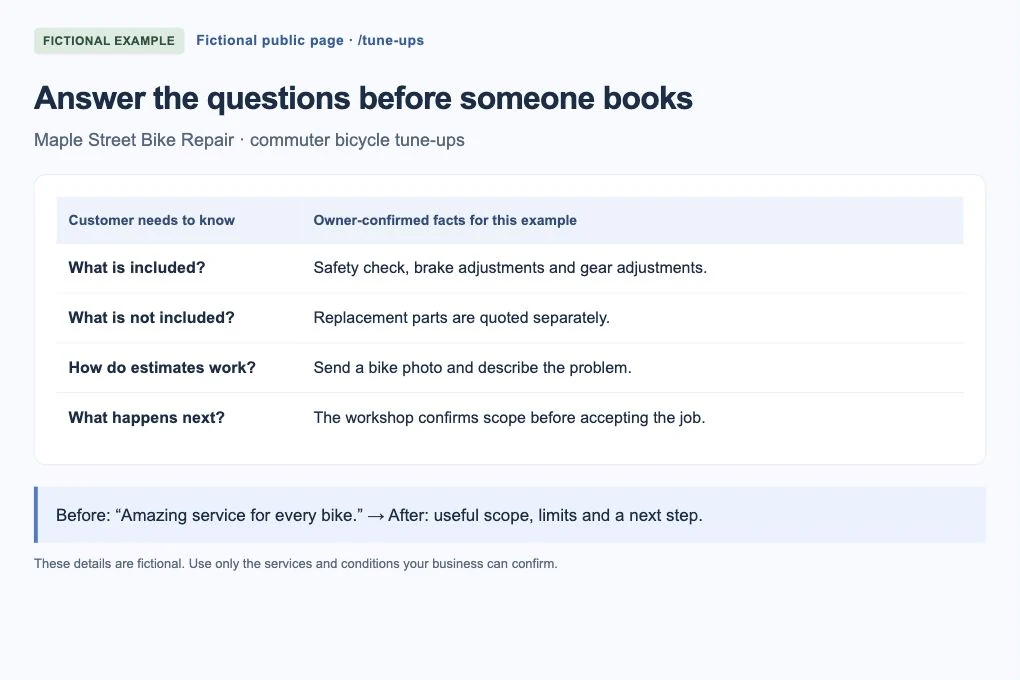
“Amazing service for every bike” says little. In our fictional example, the owner confirms: “Our commuter tune-up includes a safety check and brake and gear adjustments. Replacement parts are quoted separately. Send a bike photo and describe the problem to request an estimate.” Only copy the pattern, not these business facts.
 Open larger image ↗
Example screen Fictional service-page example. The business has confirmed these details for the lesson. Replace them with your own verified scope and process; do not copy the promises. Make the next step easy to find.
Place a relevant Contact or Book link near the answer. Try it on a phone. Keep the contact method and service area consistent with the rest of the site and profiles you legitimately manage.
Ask your website manager to check search access.
Public content should be accessible to the relevant search crawler. OpenAI’s search and model-training controls are independent; review OAI-SearchBot without silently changing GPTBot preferences. Keep private pages protected.
Record what changed and test carefully later.
Save the page address, change date and confirmed wording. Use a repeatable question-and-source check if you want to monitor AI answers. Do not attribute a later mention to this edit without stronger evidence.
Make your business easy to identify
Start with facts a customer can check. Use the same business name, category, service area, contact details, and core offering across your website and legitimate profiles. Create focused service pages that state who each service is for, the problem it solves, relevant limits, and the next step.
Support important claims with evidence. Author information, real policies, detailed case studies, customer reviews on appropriate platforms, professional listings, and relevant press can all make the business easier to verify.
- Use one clear business description across core pages
- Give each important service a dedicated, useful page
- Publish pricing or buying criteria when appropriate
- Add evidence that a buyer can independently check
- Correct inconsistent information on major profiles and directories
Answer the questions that decide the purchase
Generic definitions rarely differentiate a business. Better pages answer questions about fit, tradeoffs, cost drivers, process, timing, requirements, risks, and alternatives. A clear answer near the relevant heading helps people; it also makes the page easier to quote accurately.
Measure progress with a stable set of buyer prompts and supported citations. Track competitors that appear, the sources used, and the pages you need to strengthen. Treat movement over time as evidence, not as a promise of future placement.
If you get stuck
You cannot publish a fixed price.
Explain what affects the estimate and what details a customer should provide. Do not invent a price for the sake of a complete-looking page.
The page still does not appear in an AI answer.
Eligibility and clear content do not guarantee selection. Keep improving useful information and investigate sources rather than buying promised mentions.
Your finish-line check
A customer can identify the real service, its limits and the next step, and the published claims have an owner-confirmed basis.
Keep a note of the page or setup you checked, what you changed and the date. You can follow the written steps without buying an AI Search Signal report. Any optional subscription tools are labeled separately.