
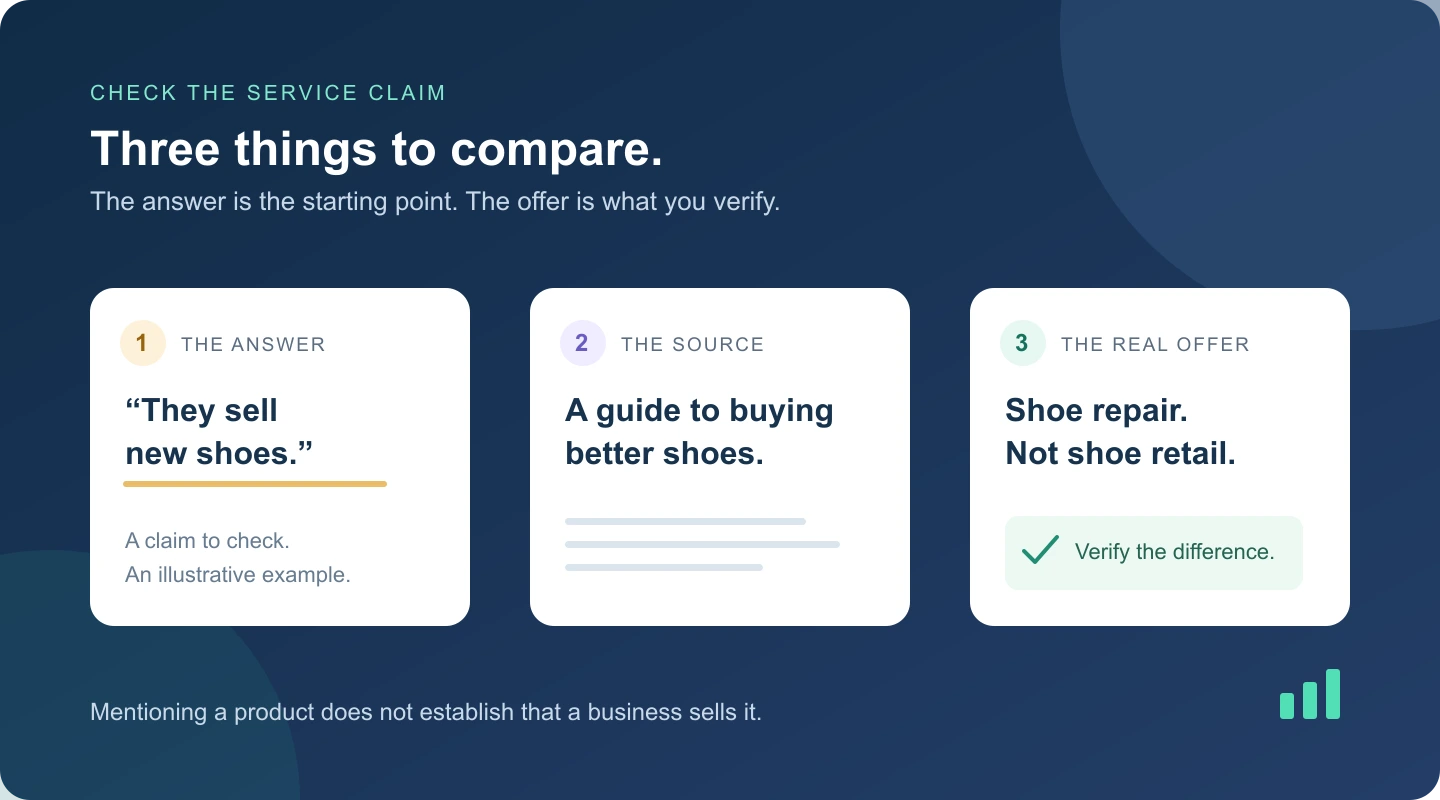
A customer asks for a service you have never offered. When you explain, they send a screenshot: ChatGPT says you do it. You now have two jobs: help the customer understand your actual offer, and work out whether there is an inaccurate public record worth correcting.
Save the exact claim and inspect any source attached to it. Compare what the answer says, what the page actually says, and what your business provides. Those can be three different things. Change a page or listing when the evidence supports a correction, rather than treating every wrong answer as a reason to rewrite your website.
OpenAI’s guidance on reviewing ChatGPT’s work recommends checking important claims, current source material, and unsupported assumptions. A confident description of your business deserves the same scrutiny.
1. Save the claim before changing anything
Start with one specific statement. “ChatGPT gets us wrong” is difficult to investigate. “It says our repair shop sells new shoes” gives you something you can compare with a real offer.
Keep the exact question, the answer, the date, and any visible source links. Note the location in the question and whether the response showed web search or sources. If a customer supplied the screenshot, ask which question led to it. Keep their personal details out of any example you later publish.
Then write a one-sentence correction for your own records: “We repair footwear brought in by customers; we do not sell new shoes.” Confirm that statement with the person responsible for the service, not just an old page on your website.
A screenshot establishes what appeared in that conversation. It does not establish how often other customers see it, or why it appeared.
2. Work out which problem you actually have
When ChatGPT uses web search, it can display citations and source links. OpenAI describes how search appears in a conversation. Open the available links and read the relevant passage yourself. A familiar domain name is not enough: the page might discuss the subject without saying your business provides the service.
 View larger illustration ↗
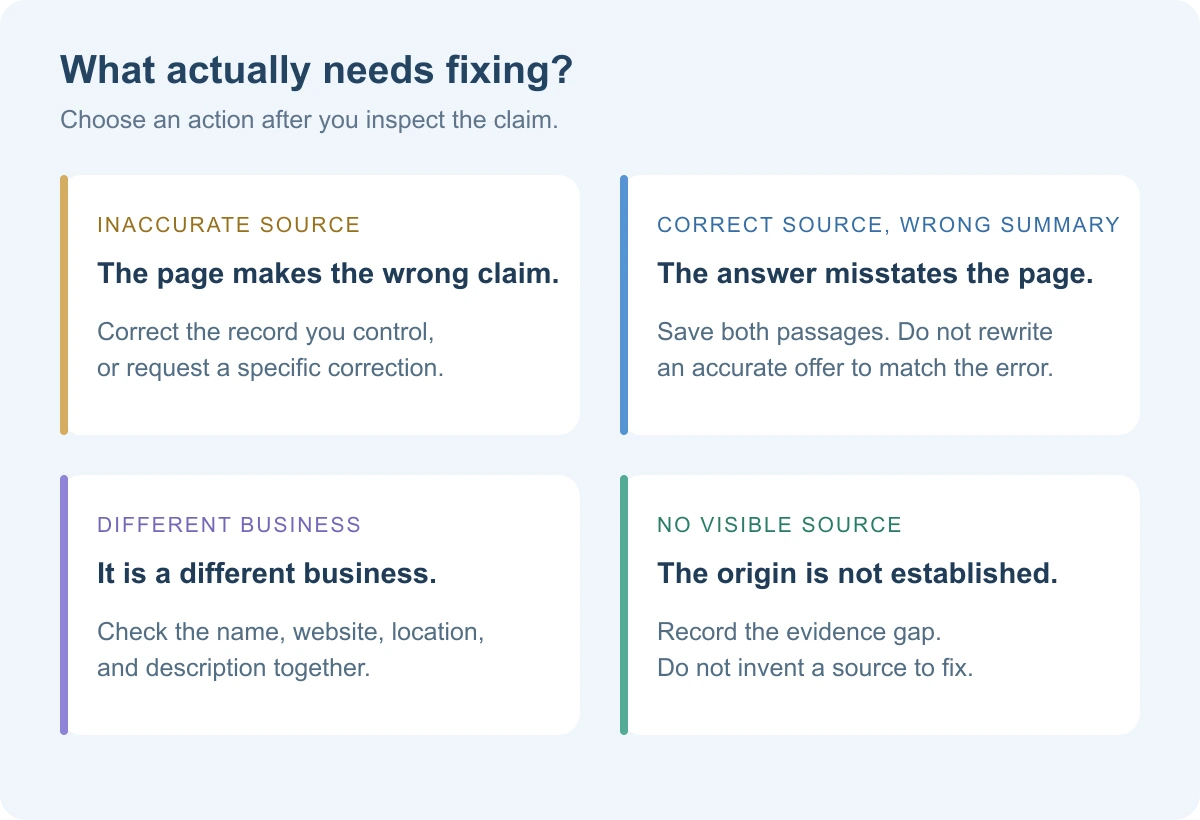
The cited page really does describe a service you do not offer
It could be an old service page, a directory description, a partner profile, or a promotion that no longer applies. Save the wording and check who controls that record. A specific correction is more useful than a general request to “update our AI information.”
The page is accurate, but the answer misreads it
A shoe-repair guide might explain when a worn pair should be replaced. That does not make the repair shop a shoe retailer. Similarly, a company can publish installation advice without offering installation.
Save the answer beside the source passage. If readers can already understand the distinction, keep the useful page. If the wording genuinely blurs advice and services, clarify that wording. The mistake alone is not proof that the page needs changing.
The source belongs to another business
Compare the business name, website address, location, and service category. If a similarly named company appears in the source, record the mismatch. Review your own identity information for ambiguity, but do not assume an unrelated company’s accurate page is yours to correct.
There is no visible source for the claim
Mark the source as unknown. If web search is available, you can ask a fresh, neutral question with sources and inspect that separate result. A later source does not prove where the earlier answer came from.
Do not guess that a particular directory caused the error merely because you found an outdated listing there. Correct a listing that is wrong, but keep the cause of the original answer unconfirmed.
3. Correct the smallest record that is actually wrong
For a page you own, edit the inaccurate sentence and check the published version. Review nearby headings, service lists, booking instructions, and any structured information your website manager maintains. They should describe the same real offer.
If the service has been retired, remove invitations to book it or explain its current status where that history is still useful. Do not promise an alternative unless you actually provide it. Avoid deleting useful articles simply because they mention a service you do not sell.
For a third-party listing, use the site’s editing process or send the owner the exact claim, the correction, and a current reference page. Save the request and its outcome. You can ask for a change; you cannot assume it has been made.
For local businesses, also check your Google Business Profile when relevant. Google says the services editor is available to businesses in certain categories, and explains how to edit or remove a listed service. That is a way to correct your Google profile, not a direct control over ChatGPT.
4. Make your service boundaries easy to understand
A useful service page tells a customer what they can hire you to do. It does not need a long catalogue of everything you refuse to do. Add a short boundary statement when it resolves a realistic misunderstanding.
A repair shop, not a shoe retailer
Too vague: “Everything you need for better footwear.”
Clearer: “We repair leather shoes and boots, including heels, soles, and stitching. Bring your existing footwear for an assessment. We do not sell new shoes.”
The improvement is the concrete description of the offer. The final sentence addresses a particular confusion. It is not a special instruction that forces an AI system to respond a certain way.
The same principle applies across different businesses:
- Advice versus service: “This guide explains installation. We supply the parts; we do not provide installation.”
- Repair versus replacement: “We repair customer-owned equipment. We do not sell replacement machines.”
- One task versus an entire project: “Our service covers furniture reupholstery. It does not include structural repairs to the frame.”
These examples are illustrative, not statements about actual businesses. Use them only when the distinction is true for yours. Put the clarification beside the relevant offer or enquiry instructions, where a customer is likely to need it.
5. Keep a small service-claim worksheet
You do not need a giant audit to resolve one misleading claim. Use a record like this to keep facts, suspected causes, and actions separate.
| What the answer claims | What you verify | A suitable action |
|---|---|---|
| “The shop sells new shoes.” | The cited guide discusses replacing shoes; the service page offers repairs only. | Check whether the guide needs a brief clarification. Preserve the correct service page. |
| “The company still offers installation.” | An old listing includes installation, which the business has stopped providing. | Request a correction to that listing and check the current website wording. |
| “This supplier repairs equipment.” | No source is shown for the repair claim. | Record the missing source. Do not invent an attribution. |
For your own entries, add the question, date, source URL, confirmed offer, person responsible, correction date, and a follow-up note. Keep the original observation when you add a later result, so you can see what changed.
6. Give the customer a clear answer
The customer may have relied on an answer that looked convincing. Explain your actual service without making them feel foolish for asking. You can adapt this reply:
Thanks for checking with us. That description is not accurate for our business. We offer [actual service], but we do not provide [requested service]. You can see our current services here: [link].
If you need help with [relevant task you genuinely handle], please send us [the information needed for the next step].
Leave out the second paragraph if there is no relevant alternative. Avoid offering a price, warranty, turnaround time, or referral you have not confirmed.
7. Recheck the claim without chasing every answer
After a correction is public, repeat the original question on a later date and record the conditions. Keep the wording, location, and search setting comparable where possible. Save the new answer and its sources beside the original record.
A corrected reply in your own conversation does not show what other users will receive. Likewise, one later answer that gets it right does not establish a lasting change. Look for repeatable observations before describing the issue as resolved.
If the answer offers a feedback option, you can flag the incorrect claim and point to the accurate public page. Treat that as a report of a problem, not a guaranteed correction or timetable.
Stop rewriting once the relevant public records are accurate, customers can understand your offer, and any outstanding source issue has a clear owner. Changing truthful copy repeatedly makes it harder to tell which change, if any, was useful.
Questions business owners ask
Should I publish a separate “services we do not offer” page?
Usually, a brief clarification on the relevant service or enquiry page is more useful. A separate page is worth considering only when the misunderstanding is recurring and customers genuinely need a longer explanation.
Should I delete an article about a service I do not provide?
Not solely because it mentions that service. Keep helpful advice when its purpose is clear. Review the wording if it could reasonably be mistaken for an offer to perform the work.
How quickly will ChatGPT change its answer?
There is no correction deadline you can responsibly promise from a website edit alone. Record when your public information changed and what later answers actually show.
Check the evidence before planning more content
AI Search Signal helps you review saved website findings and available search evidence in one place. Start with the information already saved for your business and ask whether it supports the service claim you are investigating.
A website-readiness score is not proof that ChatGPT describes your services correctly. Keep the website check and the observed answer separate.
Sources and scope
This article combines documented platform guidance with a practical editorial workflow. The examples and illustrations are fictional. They are not screenshots, customer case studies, or claims about how often a model makes an error.
- OpenAI: Use ChatGPT, guidance on checking claims, sources, and assumptions.
- OpenAI: Web search, guidance on search activity and sources in a conversation.
- Google: Manage services on your Business Profile, availability and editing guidance for service listings.
Sources checked October 27, 2026. Interfaces and features can change.