
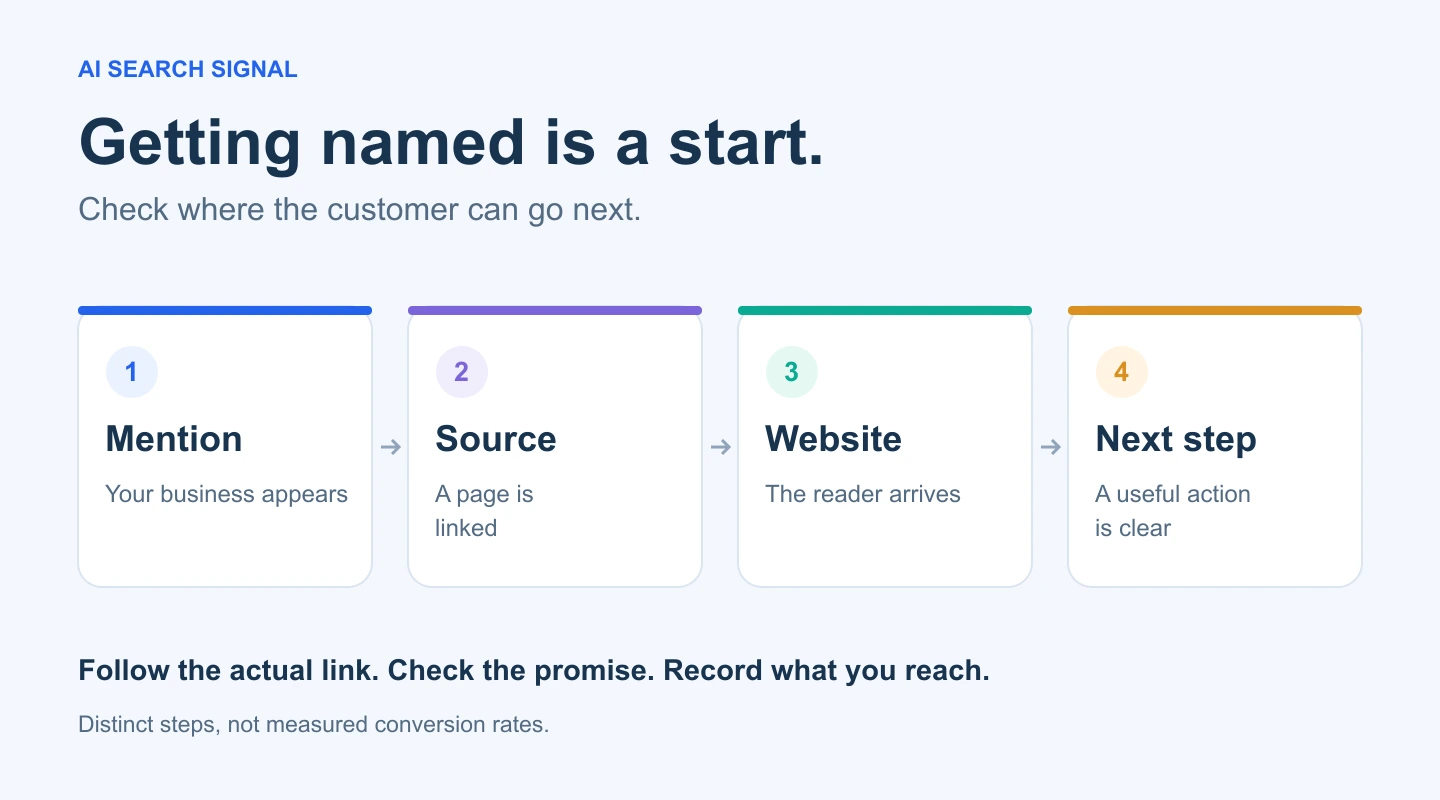
Seeing your business in an AI answer feels like a win. You save the screenshot, send it to someone on your team and hope it means more customers are on the way.
But what can a person actually do after reading that answer? Can they find the right product, reach your booking page or work out whether you serve their area?
We followed links from three saved AI answers to find out. The useful result was more specific than a mention count: different links put the reader at different points in the same buying journey.
If AI recommends your business but enquiries are quiet, check the route from the answer to the next useful action. First confirm what the answer said and linked to. Then open that exact page, follow the relevant path and compare what you can observe with your analytics. A recommendation alone cannot tell you whether anyone clicked or bought.
What we checked after the AI recommendation
We started with answers already saved in an AI Search Signal report for Find My Water Filter. The three selected answers came from Grok, Perplexity and Google AI Mode on October 28, 2026. Each answered this question:
Where can I find guidance on Water filter compatibility finders in United States?
The question asked for guidance. It did not name Find My Water Filter, request an installer or ask the assistant to place an order. That matters when judging what a useful answer should lead to.
We selected these answers because their links illustrated three different destinations: an independent guide’s homepage, its methodology page and a manufacturer’s finder. This is a worked example of following links, not a comparison of which AI platform performs best.
Find My Water Filter and AI Search Signal share ownership. We chose an owned website so we could describe the example openly. We checked the public pages on October 29, 2026, using the saved answers from the previous day. We did not run another AI scan, contact a business or place an order.
| Saved answer | Linked destination | Observed next step |
|---|---|---|
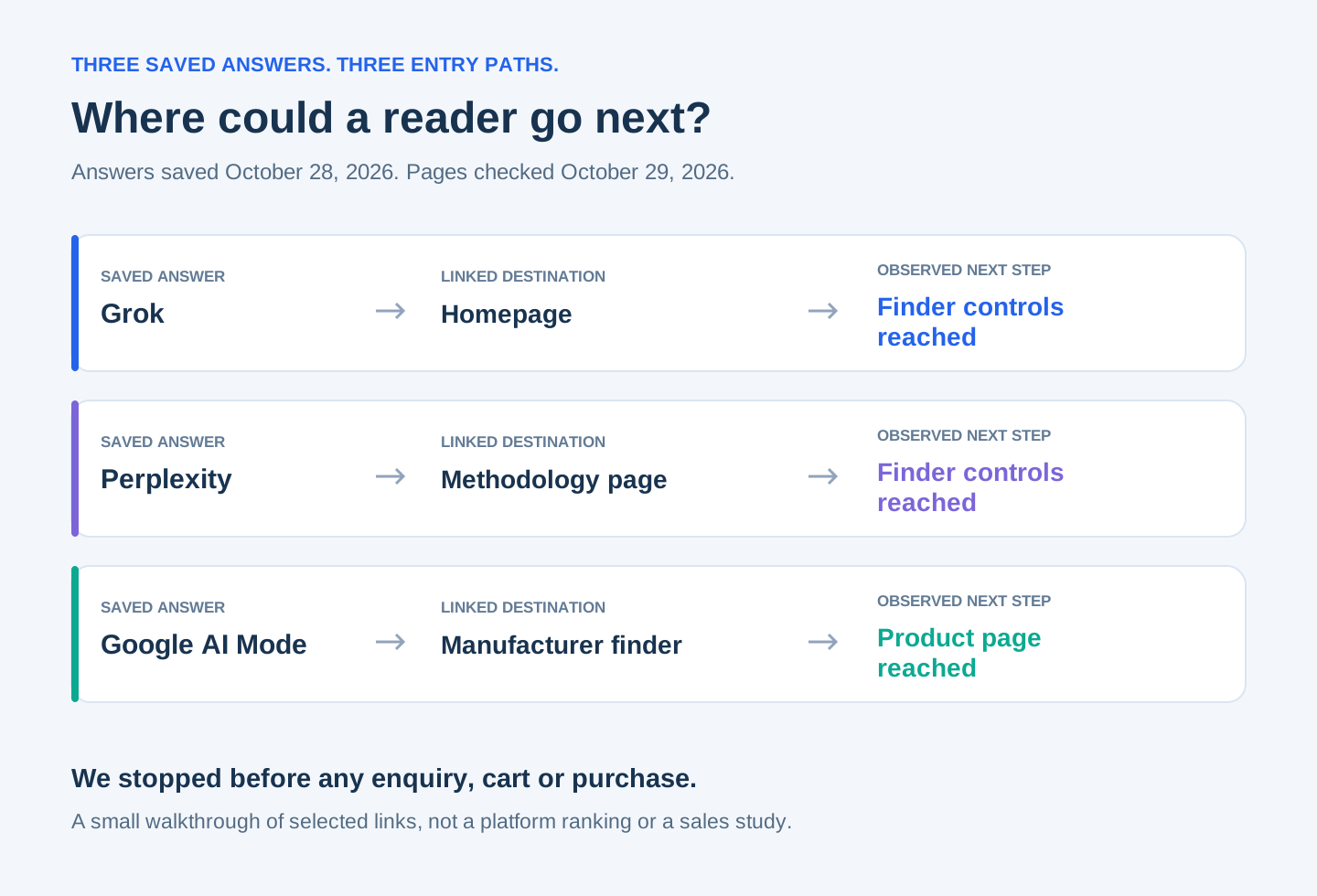
| Grok | Find My Water Filter homepage | A refrigerator filter link opened a finder with brand and model controls. |
| Perplexity | Find My Water Filter methodology page | The page explained its checks and offered a link to search a model. That link opened the finder. |
| Google AI Mode | Everydrop filter finder | Entering the public model WRS325SDHZ led to the EDR1RXD1 product page, where an Add To Cart button was present. We stopped there. |
These observations describe the routes available during our check. They do not establish how many shoppers took them, whether a filter fits a particular appliance or whether any sale followed.
The homepage recommendation gave the reader a choice
The saved Grok answer named FindMyWaterFilter.com and linked to its homepage. We opened the exact destination and looked for the next step a reader researching a replacement filter would need.
The homepage separated replacement filters from complete systems. Its refrigerator filter link opened a finder with a brand selector and an optional model field. We reached those controls through one homepage link.
That is a useful route for this question. The reader asked where to find guidance, so arriving at a guide with clear categories made sense. We would judge it differently if the answer had promised a specific product and the link left the shopper searching for it.
For your own website, start with the promise in the answer. A homepage link can be perfectly useful when someone is choosing a category. A customer trying to book a particular service may need a more direct path.
The citation page was doing a different job
The selected Perplexity answer included the Find My Water Filter methodology page among its sources. That page explained how the guide researches model associations and keeps manufacturer references available.
It also included a link to search a model. We followed that link and reached the refrigerator finder.
Here, the cited page helped a reader evaluate the guidance before using the tool. Its purpose was different from a product page, but it still offered a relevant next step.
That distinction is easy to lose in an AI visibility report. A source may explain, verify or compare something. It does not have to be a checkout page to be valuable. The practical question is whether a reader who wants to continue can see a sensible way forward.
 View larger illustration ↗
The manufacturer finder reached a product page
The Google AI Mode answer included the Everydrop filter finder. The page asked for a refrigerator model and provided help finding that number.
For a reproducible lookup, we used WRS325SDHZ, a model published in Whirlpool’s own product information. Selecting the finder’s search action led to the EDR1RXD1 product page. An Add To Cart button was visible.
We stopped before adding anything to a cart. We did not test payment, delivery or physical compatibility. What we could verify was the path from the linked finder to a product page for that input.
This is why a useful customer journey check needs a clear stopping point. Reaching a product page, submitting an enquiry and completing a purchase are different outcomes. Write down the one you actually observed.
Why an AI mention is not a customer
Our small walkthrough found routes that let a reader continue. It did not tell us whether those routes generated customers. To answer that, you need more than the saved AI answer.
| Signal | What it tells you | What it does not establish |
|---|---|---|
| Business mention | The business appeared in the answer you checked. | That a person visited, enquired or purchased. |
| Website citation | The answer included a link to a page. | That the link supports every claim or that anyone clicked it. |
| Recorded website visit | Your analytics recorded activity under its tracking rules. | Every time AI mentioned you or every visit influenced by AI. |
| Recorded goal or key event | A configured action was recorded. | A completed sale unless the event and sales records support that meaning. |
Some people may read an answer and call the number it shows. Others may search your name later, open a different source or decide they have enough information. A neat funnel diagram cannot establish what those people did.
The value of following a link is narrower and useful: you can check whether the route works for the job the answer suggested. For a closer look at the earlier step, read how to check whether your business appears in ChatGPT.
Follow one customer task all the way to a sensible stopping point
Choose an answer that matters to your business and name the task before you open its links. For a salon, that might be finding how to book a specific treatment. For a contractor, it might be checking the service area and reaching a quote form. For a publisher, reaching the right guide or comparison can be the appropriate result.
Use the exact link saved with the answer. Going straight to the page you wish AI had linked skips the part you are trying to inspect.
You do not need to send a test lead to another company or place an order to check an entry path. On your own website, use a controlled test process if you need to verify form delivery or checkout. Keep test activity separate from real enquiries.
The answer linked to our general services page. A customer asking about weekend appointments would need to open another page to find our current booking information. We should review whether the relevant page makes that next step clear.
This is an illustrative note, not a result from our water filter walkthrough.
Fix the obstacle you can show
A slower route is not automatically a broken one. Our methodology example offered useful supporting information and a direct route to the finder. Removing that page or forcing every visitor onto a sales page would miss what it was doing well.
When you find a specific obstacle, describe it precisely. A booking link may be outdated. A cited page may describe a service you stopped offering. A product page may leave shoppers unsure which version they are viewing. Each situation calls for a different review.
| What you observe | What to review |
|---|---|
| An accurate page with a working next step | Keep the route useful. Look for other evidence before prescribing a redesign. |
| A live page with an outdated booking or product link | Correct the destination you control and retest the original route. |
| An answer promises something the linked page does not support | Save the mismatch. Check the current facts and the other cited sources before assigning a cause. |
| A directory or outside article contains outdated information | Identify the exact claim and ask its publisher for a factual correction. |
| A good route but few recorded enquiries | Review tracking, customer intent and the actual enquiry process before blaming the AI mention. |
If your saved answer describes a service you never provided, use our guide to what to do when ChatGPT says you offer a service you do not. Correcting the facts is a different job from making a good booking link easier to find.
Why Google Analytics may not show the whole story
If you are asking why ChatGPT recommendations are not showing up as traffic, keep visibility and recorded visits separate. An answer can mention your business without producing a click to your website.
Attribution can also be incomplete. Google explains that direct traffic has no clear referral source. Its examples include typed addresses and missing traffic information, and it notes that redirects and blockers can affect source details.
That gives you a reason to inspect your measurement setup. It does not give you a reason to label all direct traffic as AI traffic. Record what your reports identify and leave the rest uncertain.
Compare referral sources with the landing pages and actions actually recorded for the same period. If you also ask customers how they found you, keep those self reported answers separate from click attribution. Both can be useful without proving the same thing.
Signal Analytics, Google Analytics and Google Search Console also measure different activity. For the basics, see how to track website visitors without confusing the numbers.
A booking problem deserves its own evidence
This question extends beyond shopping. In a public barber discussion, one participant said AI incorrectly told people they did not offer online booking, although the link was on their business page.
That is a reported experience, not something we independently reproduced. It illustrates why a business owner should inspect the specific answer and booking route instead of assuming that being mentioned means the customer received accurate instructions.
For a booking business, your check might stop at an available booking page with the right service. For a retailer, it might stop at the correct product and purchase option. For an educational website, it may stop at a useful answer and a trustworthy next source. Choose the task that fits the business.
Use your AI visibility report as the starting point
AI Search Signal brings collected answers, business mentions, website citations and their sources into the same dashboard. Its six platform views cover ChatGPT, Google, Perplexity, Grok, Gemini and Copilot. Google includes AI Overviews and AI Mode where collected. Availability and collection dates remain part of the evidence.
Open an answer involving your business, check its wording and follow the relevant links. Historical research and fresh question checks stay separate, and unavailable answers are not completed checks.
Then review recorded website activity through Signal Analytics or your connected Google Analytics property. Use Google Search Console for its separate picture of Google Search performance. These views help you ask better questions about what happened; they do not prove that an AI mention caused a sale.
After asking whether AI recommends your business, ask what a potential customer can actually do with that recommendation. A clear answer and a usable next step are both worth checking.
Sources and method
The worked example uses three selected buyer answers saved on October 28, 2026. Public page routes were checked on October 29, 2026. Two destinations belong to Find My Water Filter, which shares ownership with AI Search Signal. No new AI questions were run for this article.
We checked entry paths and one public manufacturer lookup. We did not measure customer behaviour, verify product performance, submit enquiries or complete a transaction. Website content and AI answers can change.
- Find My Water Filter homepage: the destination named in the selected Grok answer.
- Find My Water Filter methodology: a source in the selected Perplexity answer.
- Find My Water Filter refrigerator finder: the next step reached from both owned pages.
- Everydrop filter finder: a source in the selected Google AI Mode answer.
- Whirlpool model information: the published appliance model used for the demonstration.
- Everydrop product destination: the page returned for that lookup during our check.
- Google Analytics documentation: the meaning of direct traffic and common sources of missing attribution.
- Barber discussion: a separate, anecdotal report about inaccurate booking information.
Frequently asked questions
Does a ChatGPT recommendation count as a website visit?
No. It shows that your business appeared in the answer being reviewed. A website visit is a separate action that your analytics may record under its tracking rules. Someone may read the answer without clicking, or contact the business another way.
Why does AI mention my business but send no recorded traffic?
The answer may not produce a click, may link to an outside source, or may lead to a visit whose referral details are missing. Follow the exact saved links and review the available landing page and source data. The mention alone cannot identify the explanation.
Should AI always link directly to a product or booking page?
The useful destination depends on the question. A guide or methodology page can help someone research a choice, while a ready customer may need a product, booking or contact page. Check whether the destination and next step fit what the answer actually suggested.
Can an AI visibility report prove that a recommendation generated a sale?
A saved answer can establish what appeared in that checked response. Demonstrating a sale requires separate, appropriately configured action or transaction records. Keep mentions, citations, visits, enquiries and completed sales distinct.